Levels
What is an order block
The last candle before price left in a hurry, and why price so often comes back to it.
An order block is the last candle in one direction before price moved hard in the
other. Before a big push up, the last down candle. Before a big drop, the last up
candle. That candle is where the size went in.
Why price comes back
Large orders do not fill in one go. When a desk is buying more than the book can
absorb, part of the order fills and part does not. Price leaves without them. When it
comes back to that same area, the rest of that interest is still sitting there. That
is the whole idea, and it is why the reaction usually comes on the first touch rather
than the third.
How to mark an order block
- Find the move first, not the candle. A real order block has a
strong displacement leaving it. No displacement, no order block, just a candle. - Take the body and wick of that last opposite candle. That is the
zone. Do not stretch it to fit. - The first touch is the one that counts. Each time price returns,
more of the resting interest is used up. By the third visit there is usually nothing
left, which is why we mark a zone as used once price has been through it.
The honest part
You can draw an order block on any chart after the move has happened and it will
look perfect every time. That proves nothing. The only version worth anything is the
one marked before price returns, which is why we put them on the live chart
as they form and leave them there whether they work or not.
Free download
Gold Levels Cheat Sheet (PDF)
Order blocks, fair value gaps, PDH and PDL, and the session times in nine countries. Two pages, no email needed.
How we use order block on the live chart
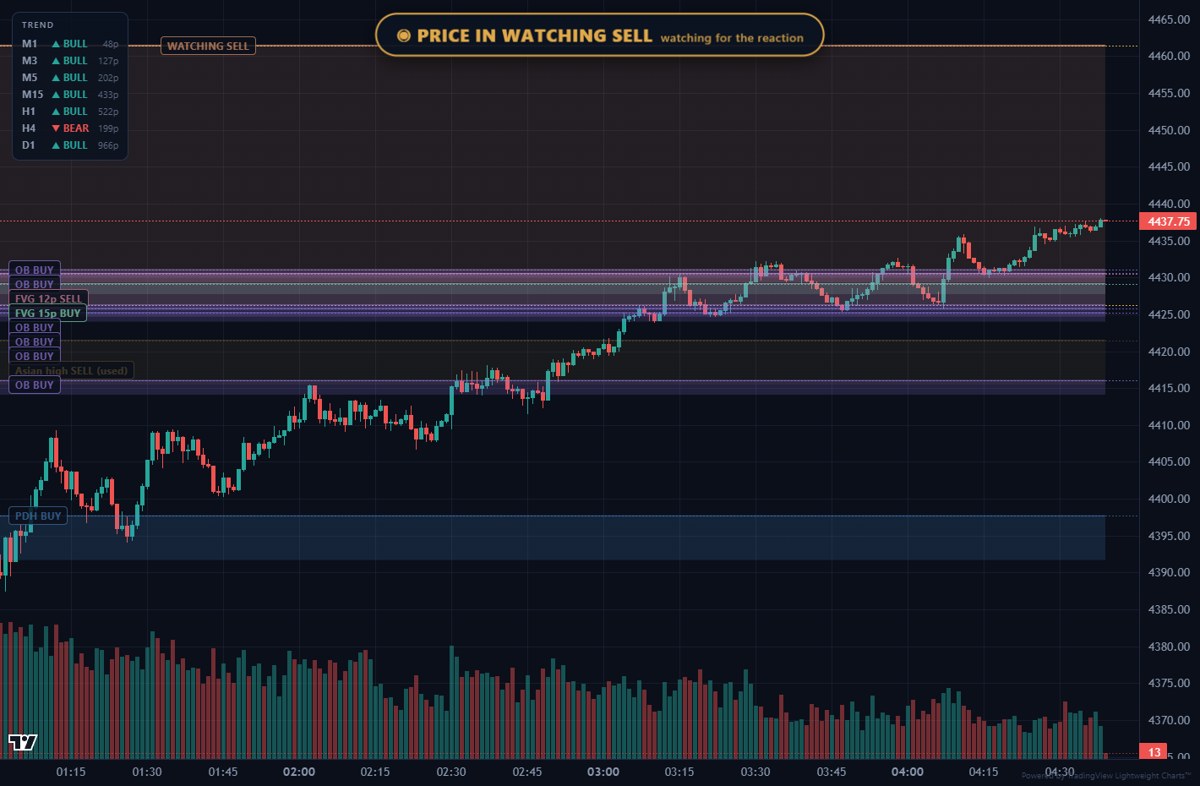
Everything above is marked on our chart while the session runs, not drawn in afterwards. Order block goes on before price gets there, never after. The zones get shaded, each one carries its name and its price range, and a zone turns pale once price has already been through it. When price is sitting inside one, a banner says so on screen. That is deliberate: a level you only see after the move has happened proves nothing.
The panel in the corner shows whether each timeframe is above or below its 50 EMA, from one minute up to the daily, and how far away that average is in pips. When the short timeframes disagree with the daily, the level usually holds. When they all point the same way, it usually breaks. That is not a rule, it is a lean.
Gold is not a quiet market. It can move a hundred pips in an hour on a headline and spreads widen when it does. Position size matters more than entry on an instrument like this, and a stop belongs on the far side of the level rather than right against it. The World Gold Council publishes the demand and supply data behind the longer term moves if you want the fundamental side.
See order block live
We run a live chart through every session with order block marked on it, the zones shaded, and every order block and fair value gap labelled as it forms. Watch the live chart and you can see order block being used in real time rather than explained after the fact.
Every trade we close is published in pips on the results page, wins and losses both, with the date it closed and how far it ran before the exit. Nothing is left out and nothing is cherry picked. If you want to know what your own spread and commission are taking out of your results, the cost calculator works it out for a year on your own numbers.
Related: gold trading hours · order block · fair value gap · PDH and PDL
Education only, not financial advice. Trading gold carries a high level of risk and past results do not predict future results.